
From landfill to the power grid: the new generation of plants aiming to turn waste into energy without releasing its carbon

Published on 19 July 2026 at 02:40 GMT
By Editorial Team SDG9
For decades, the destination of most municipal waste was the same: landfill. There, it remains buried for years or even centuries, occupying vast areas of land while organic matter gradually decomposes and releases methane. Today, however, a growing number of European countries are pursuing a different strategy: recovering the energy contained in waste that can no longer be reused or recycled.
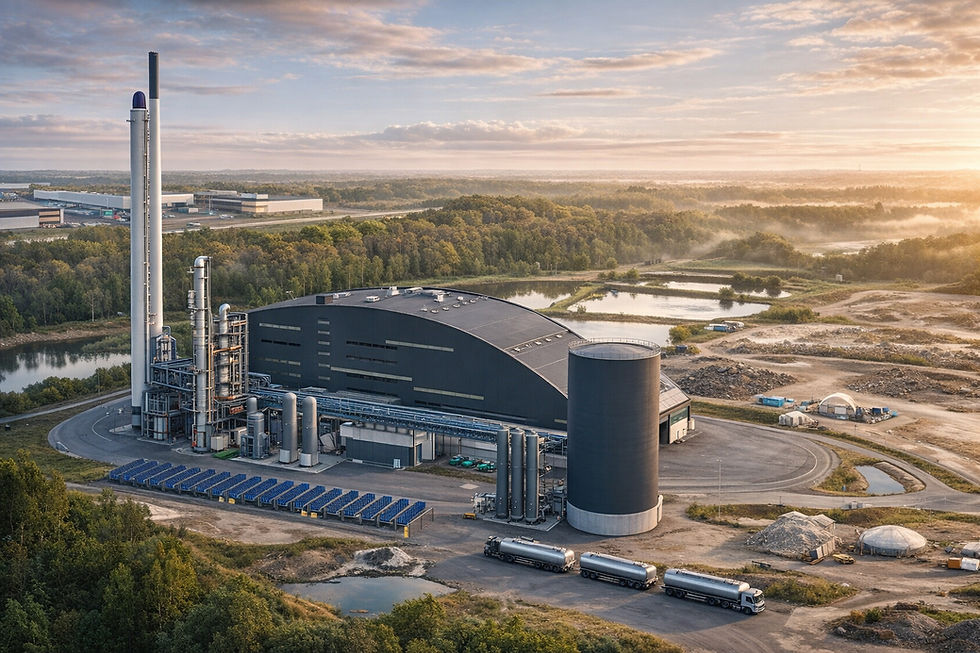
Waste-to-energy is not a new technology. Countries including Sweden, Denmark, Germany, the Netherlands and Japan have incorporated it into their waste management systems for decades. The principle is relatively straightforward. The residual fraction of municipal waste is fed into high-temperature furnaces, where the heat generated is used to produce steam that drives turbines and generates electricity. In many facilities, the remaining heat is also supplied to district heating networks, significantly improving the overall energy efficiency of the process.
Although these plants are often described as burning “unsorted waste”, the statement requires some clarification. Municipal waste generally arrives largely mixed after collection, but certain bulky items and specific materials are usually removed before combustion. Metals are also recovered from the bottom ash after the process through mechanical separation systems. Nevertheless, the vast majority of the residual waste stream is fed directly into the furnace.
The principal advantage of this approach over landfill is widely recognised. A modern waste-to-energy plant can reduce the volume of waste requiring landfill by around 90 per cent. By preventing large quantities of organic material from remaining buried for long periods, it also helps to reduce methane emissions, a greenhouse gas whose global warming potential is significantly higher than that of carbon dioxide over the first twenty years following its release.
However, waste-to-energy also presents an obvious challenge. Every combustion process produces carbon dioxide. Part of that CO₂ originates from biogenic materials such as paper, cardboard, wood and food waste, while another proportion comes from plastics manufactured from fossil fuels. For this reason, although these facilities reduce reliance on landfill, they cannot be regarded as carbon-free.
This is precisely where one of Europe’s most significant areas of innovation is now emerging.
Rather than replacing waste-to-energy, several projects are seeking to equip existing facilities with systems capable of capturing carbon dioxide before it leaves the chimney. Known as carbon capture and storage (CCS), the technology separates CO₂ from the flue gases, compresses it and allows it to be transported for permanent storage in deep geological formations.
If the system captures a sufficiently high proportion of the carbon emitted, the plant’s net greenhouse gas emissions can be reduced substantially. Where the captured CO₂ originates from biogenic materials and is permanently stored, some international organisations recognise that the process can even result in net carbon removal from the atmosphere.
One of Europe’s most advanced initiatives is being developed in the Italian city of Ferrara. Supported by the European Union’s Innovation Fund, the Ferrara project aims to integrate carbon capture into an existing waste-to-energy facility with the objective of capturing around 90 per cent of the plant’s emissions, approximately 64,000 tonnes of CO₂ each year. If the planned performance is achieved, it would become one of the first industrial-scale demonstrations of combining waste-to-energy with carbon capture in this type of facility.
Alongside this initiative is the INNOZhero project, also supported by the European Union’s Innovation Fund. Its concept goes a step further by integrating carbon capture with transport and permanent geological storage as part of a wider district heating and waste management system. According to documentation published by the European Commission, the project is expected to capture approximately 200,000 tonnes of CO₂ each year and avoid around 1.9 million tonnes of cumulative emissions during its first ten years of operation, provided the planned technical performance is achieved.
These projects represent an important shift in perspective. For many years, the debate surrounding waste management has centred on a seemingly simple question: is it better to bury waste or burn it? Today, a different question is beginning to emerge: if part of our waste can no longer be recycled, can its energy be recovered without releasing its carbon into the atmosphere?
The answer is not yet definitive. Carbon capture and storage remains a technically complex and costly technology whose widespread deployment depends on the development of dedicated transport and long-term storage infrastructure. Compared with conventional waste-to-energy, its commercial implementation is still at a relatively early stage.
At the same time, other technologies such as gasification, pyrolysis and plasma gasification continue to evolve and may play an important role for certain waste streams. However, at present, none has demonstrated, on a broad commercial scale for mixed municipal waste, the ability to replace conventional waste-to-energy plants.
In any case, the technical and regulatory consensus across Europe remains clear. Waste prevention, reuse and recycling continue to occupy the highest levels of the European Union’s waste hierarchy. Energy recovery is intended for waste that can no longer be recovered by other means, while landfill remains the least preferred option.
Rather than bringing the discussion to an end, the emergence of waste-to-energy plants equipped with carbon capture is moving the debate in a new direction. The question is no longer simply what should be done with waste, but whether unavoidable residual waste can become a source of energy with an increasingly lower climate impact. If the European projects currently under development achieve their intended objectives, the next generation of waste-to-energy facilities could represent one of the most significant advances in sustainable waste management since the widespread adoption of recycling.
Sources
European Commission – Innovation Fund projectsInnovation Fund project portfolio, including CapturEste (Ferrara) and INNOZhero, with official project descriptions, objectives and expected CO₂ reductions.
European Commission / CINEA – INNOZhero Project FactsheetOfficial factsheet describing the INNOZhero project, including carbon capture capacity, expected emissions avoidance and implementation timeline.
European Commission – Innovation FundOfficial overview of the Innovation Fund, one of the EU’s main funding programmes supporting low-carbon technologies, including carbon capture and waste-to-energy projects.
European Climate, Infrastructure and Environment Executive Agency (CINEA)Official information about the Innovation Fund and its support for carbon capture, storage and innovative decarbonisation technologies.
More information:


