
The inequality crisis and the age of ultra-wealth


The global economy is growing, yet the benefits are flowing upwards at a historic pace. According to the World Inequality Report 2026, fewer than 60,000 individuals now command more wealth than half of the world’s population combined. This reality sits uneasily alongside international commitments to fairness, resilience and shared prosperity. At a time of climate stress, democratic fragility and rising social tension, extreme economic inequality has become not only a moral concern but a structural risk to global stability and long term sustainability.
Extreme wealth concentration is reshaping the global economy
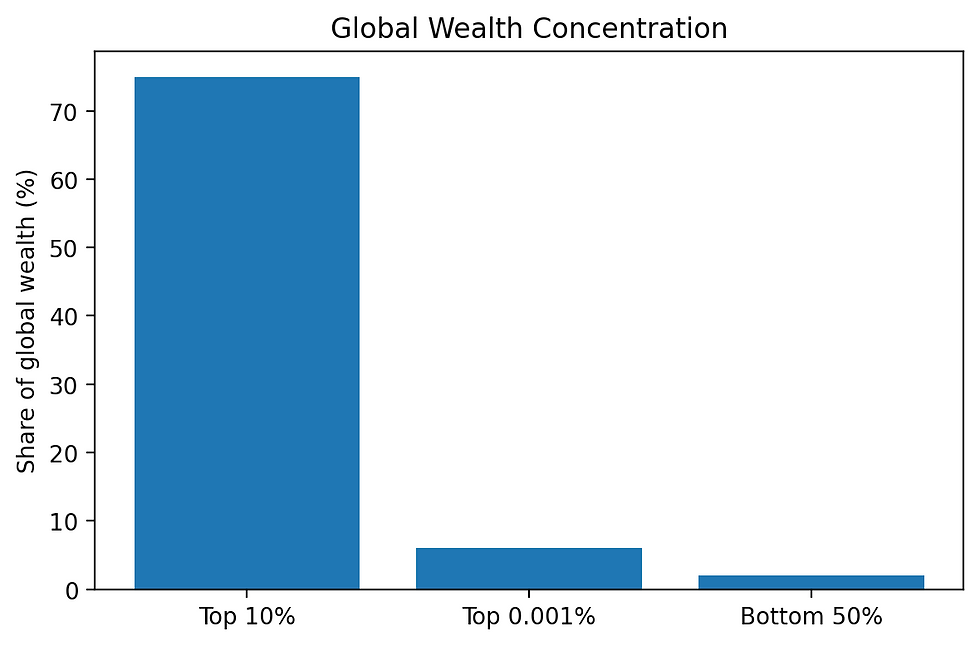
Over the past three decades, wealth accumulation has accelerated fastest at the very top. The richest 0.001 percent have expanded their share of global wealth from around 4 percent in the mid 1990s to more than 6 percent today. More broadly, the top 10 percent now own roughly three quarters of all global wealth, while the bottom half of humanity holds barely 2 percent.
This is not simply a story of high earnings. Income inequality is severe, yet wealth inequality is sharper still. Assets, property and financial capital are far more concentrated than wages, creating self reinforcing advantages that pass from one generation to the next. In practical terms, this entrenches opportunity for some while closing it off for many others.
Why inequality undermines fair development
Such imbalances matter because they shape power as much as prosperity. When wealth concentrates, political influence often follows. Large fortunes are able to shape tax systems, regulation and public debate in ways that protect their interests. This dynamic weakens democratic accountability and makes redistributive reform harder to achieve, even where public support exists.
High inequality also distorts public investment. Evidence consistently shows that unequal societies invest less in universal services such as education, healthcare and social protection. These are precisely the systems that enable social mobility and economic resilience. Without them, inequality becomes structural rather than cyclical.
At a global level, disparities between countries are reinforced by financial flows that move capital from poorer economies to richer financial centres. Narrow tax bases, debt pressures and capital flight reduce the ability of low income countries to invest in their own development, deepening global divides.
The environmental and gender dimensions
The concentration of wealth carries environmental consequences. The wealthiest 10 percent are responsible for the majority of emissions linked to private investment and consumption, while those least responsible are often the most exposed to climate shocks. Inequality therefore magnifies environmental injustice, undermining both social cohesion and climate resilience.
Gender inequality is tightly interwoven with these trends. Women continue to earn substantially less than men per hour of paid work, and far less once unpaid care labour is included. Because wealth accumulation depends on surplus income and asset ownership, gender pay gaps translate directly into gender wealth gaps over time.
What policy responses are on the table
The World Inequality Report 2026 points to tools that are neither radical nor untested. Progressive taxation on income and wealth, the closing of tax loopholes, and coordinated action against avoidance have historical precedents, particularly in the decades following the Second World War. Proposals such as modest wealth taxes on ultra high net worth individuals could generate significant public revenue, enough to transform education systems or strengthen social safety nets in lower and middle income countries.
Equally important is global cooperation. Without shared standards on taxation and financial transparency, national efforts are easily undermined. Addressing inequality within countries is inseparable from tackling inequality between them.
SDG 10
SDG 10, focused on reduced inequalities, recognises that economic disparities threaten social trust, democratic governance and sustainable development. Extreme wealth concentration runs counter to this goal by locking resources, influence and opportunity into ever fewer hands. Progress on inequality is therefore not a niche issue but a foundation for wider social and environmental goals.
The challenge is not a lack of evidence, but a lack of political will. Journalism has a role to play in making the consequences of inequality visible, connecting abstract numbers to lived realities, and scrutinising whose interests are served by the status quo.
For readers seeking deeper context, further analysis is available through ongoing global inequality research, investigative reporting on wealth and tax justice, and comparative studies of post war redistribution models. These debates will shape whether the coming decades are defined by shared progress or by an increasingly divided world.


