
Waste Warriors Society scales up waste management work across the Indian Himalayan region

A recent article about viral footage showing workers on India’s railway network throwing rubbish from moving carriages offered a blunt reminder of how easily waste can be pushed out of sight. The same images raise a quieter question with real consequences for fragile landscapes: who ends up cleaning up what others leave behind.
Waste Warriors Society has expanded rapidly since 2020, shifting from volunteer-led clean-ups to a multi-site organisation focused on systemic waste management across the Indian Himalayan Region (IHR). The group says its growth reflects rising pressure on eco-sensitive landscapes, and the need for practical services that work in remote terrain as well as in cities.
In December 2020, Vishal Kumar, an IIT BHU alumnus, became chief executive, taking over from Avinash Pratap Singh. The organisation has since grown to more than 170 “Warriors” and now operates in 10 project locations across Uttarakhand and Himachal Pradesh.
Leadership and new operational bases
The organisation’s operations have moved beyond its earlier hubs in Dehradun, Dharamshala and Corbett. It has established bases in Rishikesh, Govind Wildlife Sanctuary and Uttarkashi, signalling a push deeper into mountainous districts where waste logistics are often constrained by limited road access.
Waste Warriors Society describes its current approach as “Collection, Conversion, and Community Engagement”, a three-part model intended to combine frontline services with behaviour change and local governance support.
Community-led models in Corbett and Uttarkashi
A flagship initiative in the Corbett region, the Paryavaran Sakhi model, trains local women to manage waste collection and segregation. The programme positions participants as environmental leaders while also offering what the organisation calls dignified livelihoods.
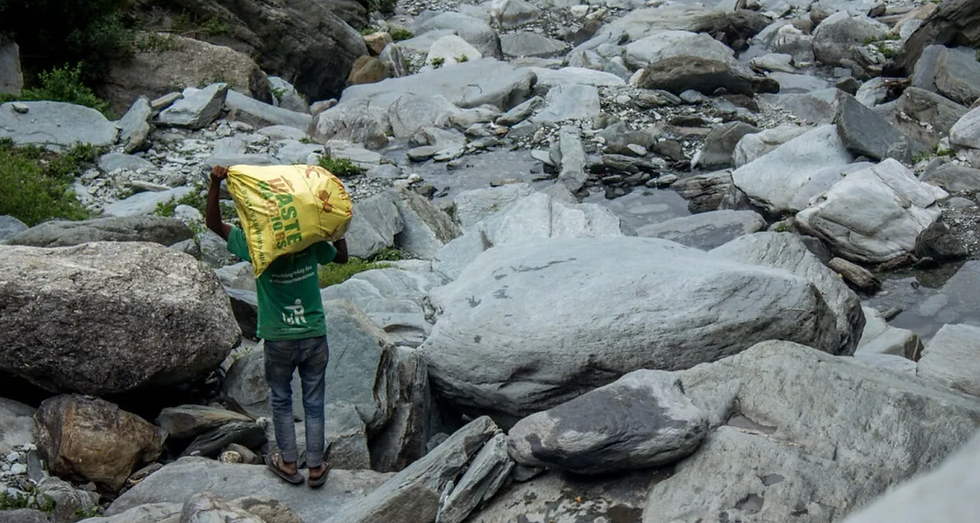
In high-altitude villages in Uttarkashi where vehicles cannot reach, “Green Workers” collect dry waste on foot, navigating steep terrain household by household. The organisation presents the effort as a way to extend basic services to settlements that are often left out of standard municipal systems.
Sorting infrastructure and measurable diversion
Waste Warriors Society operates five material recovery facilities (MRFs), where waste is sorted into more than 50 categories for recycling and processing. It says this includes the first MRF of its kind in Uttarakhand dedicated to plastic waste.
In Dehradun’s Ward 97, described as a “model ward”, the organisation reports achieving over 85% waste segregation at source through direct engagement with thousands of households. Across its portfolio, it says that during the 2023–24 financial year it processed and diverted about 1,865 metric tonnes of waste away from landfills and eco-sensitive zones.
Awards and a growing role in local policy
The group’s work has been recognised with the Keeling Curve Prize 2023 for climate action and an SDG Goalkeeper Award from the Chief Minister of Uttarakhand in 2022, linked to the sustainable development goals.
Alongside service delivery, it has increased its involvement in research and advocacy. The organisation says it is supporting gram panchayats to develop waste management by-laws and set up independent Swachhta Samitis, a move intended to embed accountability and continuity beyond individual projects.
The organisation’s expansion points to a broader shift in how waste is managed in mountain regions, where geography can make conventional collection and disposal costly and inconsistent. Its mix of local employment models, infrastructure for sorting, and engagement with village governance suggests one route for scaling services while keeping decision-making closer to communities.
For policymakers and local authorities, the work highlights the importance of enforceable by-laws, functioning segregation systems, and locally staffed operations, particularly where tourism, seasonal migration, and fragile ecosystems increase the stakes of unmanaged waste.
Further reading and image rights/credits
Youtube credits: https://www.youtube.com/@WasteWarriors


