
Reforesting Iceland – The greening of shattered stone


Published on 22 August 2026 at 05:23 GMT
By Till Heumann
In the spring of 2026, a century-old struggle for Europe’s least forested country reached a measurable milestone. Land and Forest Iceland (Land og Skógur) confirmed that national forest cover has doubled from its historical low, officially surpassing the two per cent mark.
Fuelled by state grants, the nation is planting millions of saplings annually, shifting from early botanical trials to the mass deployment of biological infrastructure. Working with NGOs, ecologists are embedding diverse, self-propagating ‘seed islands’ across barren tephra plains. This botanical engineering advances SDG 15 (Life on Land) and SDG 13 (Climate Action), showing that a millennium of ecological collapse can be reversed sustainably.
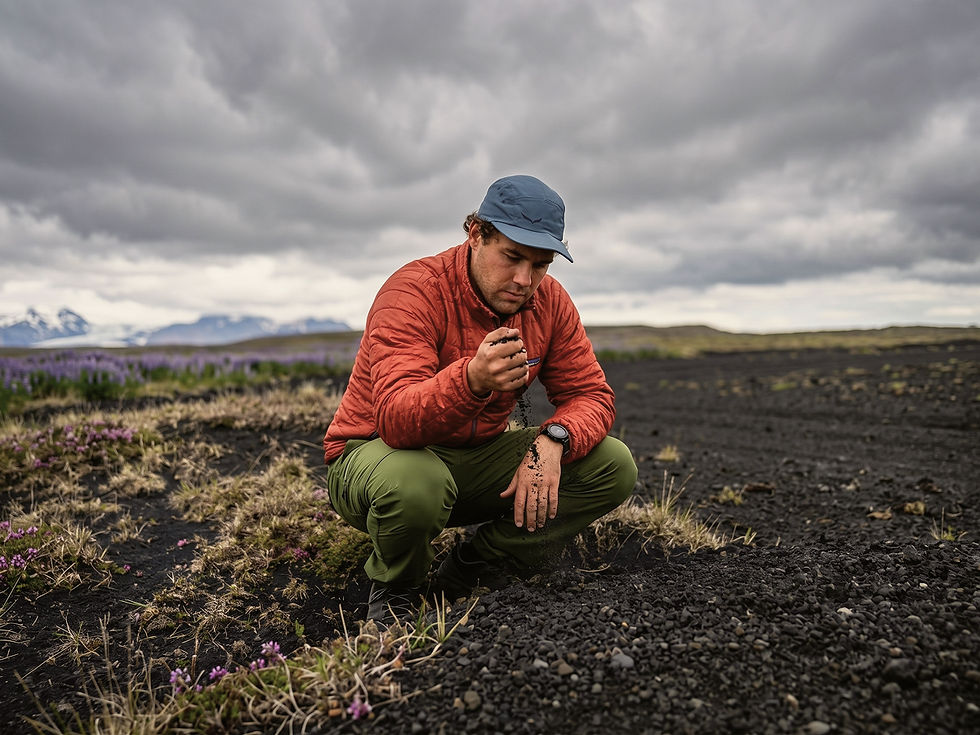
Weaving life inside the geometry of ash
A single handful of earth from the shadow of Mount Hekla appears less like soil and more like crushed glass. It is brittle, fractured black volcanic tephra, cold and rigid. The wind scrapes across this crusted surface, carrying coarse dust that chokes out fragile growth. Yet crouch down and look more closely at the fractures themselves. Beneath the sharp crust, a silent process is unfolding. A microscopic thread of white mycelium pulses through the dark grit. To the untrained eye, it is merely a fungus; in reality, it is a living extension of a nascent tree’s root system, binding the loose ash into a stable matrix.

The anatomy of a botanical vanguard
To understand the magnitude of this renewing milestone, one must trace the deep roots of the collapse that left Iceland the most deforested territory in Europe.
When the first Norse fleets arrived over a millennium ago, up to 40 per cent of the island was blanketed in dense, thriving birch woodlands. The settlers carefully dismantled this living architecture, clearing the timber for fuel, construction, and sprawling grazing fields. Within just a few centuries, the island was stripped of its protective canopy. The aeolian volcanic ash, suddenly exposed to the violent Atlantic winds, simply blew away, transforming a healthy ecosystem into an immense desert.
By the mid-20th century, Iceland's forest cover had plummeted to a perilous 0.5 per cent. The first radical attempt at ecological design occurred in 1945, when the progressive forestry director Hákon Bjarnason returned from Alaska with a suitcase full of Nootka lupine (Lupinus nootkatensis) seeds. While highly aggressive, this plant acted as a brutal, highly efficient nitrogen pump. It was the biological beta version of terraforming, hacking into the infertile volcanic sand and slowly converting it back into soil capable of sustaining larger life forms.
Today, that early intervention has evolved into a highly calibrated, multi-species living technology. The pioneer is the native downy birch (Betula pubescens), acting as the vanguard scaffold. But to build a resilient architecture, field ecologists incorporate robust conifers such as Sitka spruce (Picea sitchensis) and Siberian larch (Larix sibirica). This planned mix ensures year-round wind resistance and structural soundness.

The symbiotic engine of survival
However, these trees do not engineer this miracle alone. Here, the subterranean puzzle of the mycelium resolves itself. The tree roots physically fuse with mycorrhizal fungi—the white threads entwining through the ash. While the fungus acts as a highly efficient mining network, extracting vital water and minerals from the unfruitful volcanic rock, the tree canopy acts as a solar panel, feeding the fungus with carbon-rich sugars.
This interdependent alliance is the absolute prerequisite for survival in such hostile terrain. Joined by the tea-leaved willow (Salix phylicifolia), chosen for its strong capacity for natural dispersal, they form engineered seed islands. As these concentrated nodes of biodiversity mature, they do not purely survive; they alter their immediate environment.
“If you plant a tree, you get a tree. If you get a thousand people to plant trees, you get a forest. [...] Trees are good at sequestering carbon, making soil and creating ecosystems.”
— Dr. Þröstur Eysteinsson, former Director of the Icelandic Forest Service and a pioneering architect of Iceland's modern afforestation philosophy.*

Liquid architecture and the new ecology
In the philosophy of material ecology, the boundary between the grown and the manufactured dissolves. The Icelandic reforestation effort embodies this synthesis perfectly.
The resulting woodland is a living, breathing piece of infrastructure. Where usual land management relies on static windbreaks or synthetic geotextiles to halt erosion, the forest offers a fluid, adaptive response. The root networks communicate, share resources, and physically bind the earth's fragile crust into a resilient, shock-absorbing membrane.
As the canopy begins to close, the sensory sensation of the landscape undergoes a radical shift. The harsh, scraping acoustics of the wind-battered desert give way to a melodic sigh of leaves. The blinding, monolithic blackness of the ash is replaced by a luminous, multi-layered spectrum of green, brown, and gold. The environmental solution does not demand sacrifice, but rather improves the human experience, yielding a profound aesthetic and sensory upgrade.
Rebooting the trophic cascade
As the pioneer trees shed their leaves, they create a protective mulch that retains moisture and insulates against freezing temperatures. This newly cultivated biological shield acts as a decentralised air and water purification facility. But perhaps the strongest effect of this botanical architecture is the sudden return of complex fauna.
The architectural presence of the mixed canopy immediately alters the microclimate, triggering a trophic cascade. The redwing and the woodcock, long deprived of natural nesting architecture, return to weave their habitats into the protective forks of branches, serving as mobile vectors for distributing new seeds. On the forest floor, the Arctic fox—Iceland’s only native land mammal—finds rich new hunting grounds, while owls reclaim the upper canopy. A landscape that was acoustically dead for centuries is now buzzing with the complex frequency of a fully rebooted ecosystem.

The living blueprint for planetary regeneration
The reforestation of Europe’s most unproductive landscape is not simply a successful project; it is a monumental evidence of civilisational healing. Through relentless effort, national forest cover has gnawed its way back above the two per cent threshold, with long-term climate models projecting a considerable 12 per cent by 2100. This milestone clarifies the central claim: restoration is already underway, and the target is still ahead.
This is not a top-down bureaucratic mandate, but a distributed, open-source terraforming initiative. The national government serves as the incubator, providing vital funding, while agile NGOs like Mossy Earth and thousands of local volunteers carry out precision planting. By systematically restoring its lost woodlands, the nation is providing a replicable, living framework for global climate action. The central claim is simple: with collaborative effort, patience, and the deliberate application of living matter, we possess the power to heal the world and render the future breathtakingly beautiful.
Further information:
The Icelandic Forest Sector: A historical and scientific breakdown of forestry in a naturally treeless land, detailing the empirical success of pioneer species.
Mossy Earth Reforesting Iceland: An in-depth look at the on-the-ground execution of creating resilient seed islands near Mount Hekla.
Land and Forest Iceland (Land og Skógur): Current Afforestation Statistics and the Vorviður Grants: 2026.
Geography Realm: Iceland's Long Road to Reforestation.
Land and Forest Iceland (Land og Skógur): The official national agency resulting from the 2024 merger of the Icelandic Forest Service and Soil Conservation Service.
Government of Iceland / Climate Action (2026 Update): Current legislation and funding allocation integrating forestry directly into national carbon neutrality targets.
* Forests Grow in Iceland Statement — Dr. Þröstur Eysteinsson, former Director of the Icelandic Forest Service [https://www.skogur.is], detailing the empirical historical framework and scientific milestones of national afforestation and pioneer species recovery via video statement. [https://www.youtube.com/watch?v=hHz6bgZXDbk]


