
Women defending land and water are reshaping environmental leadership


Published on 23 July 2026 at 02:34 GMT
By Editorial Team SDG5
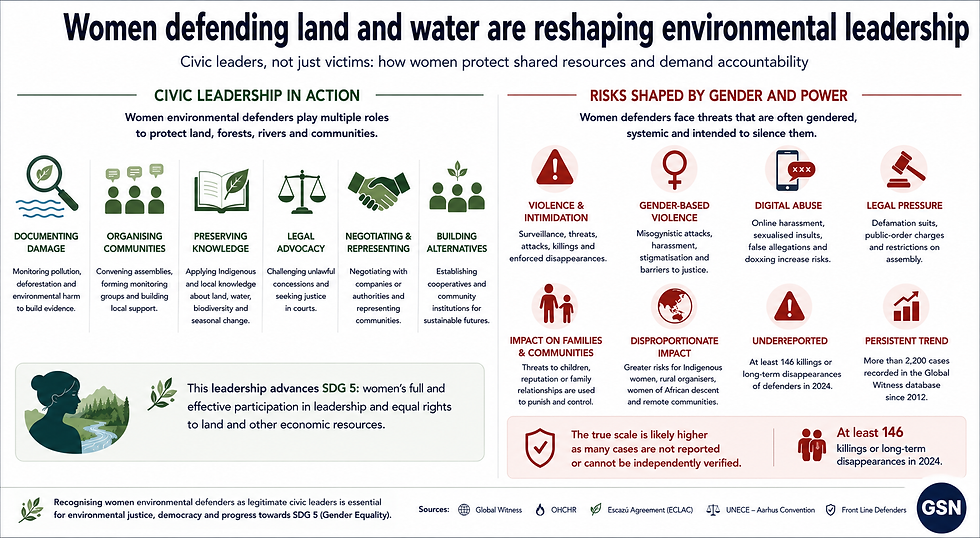
Women protecting rivers, forests, farmland and coastlines are often described through the dangers they face. Those dangers are real, but the emphasis can obscure a more important public-interest story. Women environmental defenders are organisers, negotiators, researchers, legal advocates and community representatives whose work influences how natural resources are governed. Their leadership is not confined to protest. It includes documenting pollution, challenging unlawful concessions, preserving Indigenous knowledge, convening village assemblies and pressing public authorities to enforce environmental law.
Across regions, their work connects everyday survival with wider questions of democratic accountability. A contaminated river can affect drinking water, farming, fishing and public health at the same time. Forest clearance can disrupt food systems, cultural practices and local economies. When women organise around these pressures, they are frequently defending both shared natural resources and the right of communities to participate in decisions that shape their future.
Leadership beyond victimhood
The language used to report on women defenders matters. A narrow focus on victimhood can unintentionally reduce experienced civic actors to the violence directed against them. Women defenders often hold detailed knowledge of water sources, land use, seasonal change and household needs because of their social and economic roles. Indigenous women may also carry intergenerational knowledge linked to territory, biodiversity and customary governance.
That knowledge can become political leadership. Women organise monitoring groups, collect testimony, build alliances with lawyers and scientists, communicate with journalists and represent communities before courts or public agencies. In some cases, they negotiate directly with companies or local authorities. In others, they establish cooperatives and community institutions that offer alternatives to extractive or environmentally damaging development.
This work is especially significant where women have limited formal ownership of land or remain underrepresented in public decision-making. SDG 5 (gender equality) includes women’s full and effective participation in leadership and equal rights to economic resources, land and other forms of property. The connection is practical rather than symbolic. Participation in environmental governance is weakened when women who depend on land and water are excluded from decisions about them.
Risks shaped by gender and power
Land and environmental defenders of all genders may face surveillance, intimidation, arbitrary detention, criminalisation, attacks and killings. Global Witness documented at least 146 killings or long-term disappearances of land and environmental defenders in 2024 and more than 2,200 cases in its database since 2012. The organisation also cautions that the true scale is likely higher because many cases are not reported or cannot be independently verified.
Women defenders can face additional forms of pressure linked to gender. The Office of the United Nations High Commissioner for Human Rights has highlighted misogynistic attacks, gender-based violence, harassment, stigmatisation and barriers to justice affecting women human rights defenders. Threats may target their children, family relationships or reputation, seeking to punish them not only for their public work but also for challenging expectations about women’s place in community and political life.
Digital abuse has expanded this pressure. Online campaigns can spread sexualised insults, false allegations and personal information, increasing risks beyond the original environmental dispute. Legal pressure can also be disguised as ordinary enforcement through defamation complaints, public-order charges or restrictions on assembly. These tactics may consume time and money, isolate organisers and discourage wider community participation even when cases do not result in conviction.
The risks are often intensified for Indigenous women leaders, rural organisers, women of African descent and defenders working in remote areas. Distance from legal services, weak institutional presence and disputes over formal or customary land tenure can make protection more difficult. In these settings, an attack on a woman leader can also damage the collective organisation, knowledge and negotiating capacity of the community she represents.
Environmental democracy as protection
Protection cannot be reduced to emergency security measures after threats have begun. Effective safeguards also require access to environmental information, meaningful consultation, independent courts and clear rules governing land and resource decisions. When communities can obtain impact assessments, participate early and challenge decisions lawfully, disputes are less likely to be pushed into confrontation.
The Escazú Agreement, adopted for Latin America and the Caribbean, is the first regional environmental treaty to contain specific provisions for people, groups and organisations defending human rights in environmental matters. Article 9 requires parties to provide a safe and enabling environment and to take measures to recognise, protect and promote defenders’ rights. In 2024, states parties approved an action plan intended to advance implementation of these protections.
In the pan-European region, the Aarhus Convention links environmental rights to access to information, public participation and justice. Its parties established a rapid response mechanism in 2021, followed by the appointment of a Special Rapporteur on Environmental Defenders. The mechanism can receive complaints and seek protective measures where defenders face penalisation, persecution or harassment for exercising rights under the convention.
These frameworks are important because they treat defenders as participants in environmental democracy, not as external obstacles to development. Their effectiveness, however, depends on national implementation, independent investigation and the willingness of authorities to address the economic and political interests behind attacks.
From consultation to decision-making power
Inviting women to meetings does not by itself create equal participation. Consultation can remain superficial when information is technical, late or inaccessible, when meetings are held far from communities, or when women bear unpaid care responsibilities that limit attendance. Language barriers and failure to recognise customary institutions can further exclude Indigenous and rural women.
A stronger model places women inside decision-making structures from the beginning. This includes recognising women-led community organisations, providing interpretation and legal support, publishing accessible environmental information and ensuring that consultation can influence outcomes. It also requires protection plans designed with defenders rather than imposed on them. Relocation, for example, may reduce immediate danger while separating a leader from her territory, livelihood and political constituency.
Funding is another structural issue. Women-led groups often operate with limited resources despite maintaining long-term monitoring and community support. Front Line Defenders and other protection organisations have documented how defenders need combinations of legal assistance, digital security, emergency support and sustained organisational capacity. Short-term responses are valuable during a crisis, but they do not replace institutions capable of preventing reprisals and holding perpetrators accountable.

A civic role with wider consequences
Women defending land and water are not a single movement. Their positions may differ on mining, dams, agriculture, conservation, renewable energy and infrastructure. Communities themselves can contain disagreements over employment, compensation and environmental risk. Serious reporting must therefore avoid presenting every dispute as a simple conflict between a united community and an outside actor.
What connects many cases is the demand that decisions over land, forests and water should not be made without the people who live with their consequences. Women defenders often make that demand visible by translating environmental change into evidence about health, livelihoods, culture and rights. Their contribution can strengthen oversight, reveal hidden costs and improve the legitimacy of public decisions.
Recognising this leadership changes the central question. The issue is not only how to protect women after they are threatened. It is also whether public institutions are prepared to treat them as legitimate civic actors, ensure their equal participation and respond to the evidence they bring. Progress towards SDG 5 depends partly on that shift, from acknowledging women’s vulnerability to respecting their authority in the governance of shared resources.
Further information
• Global Witness, documents killings and disappearances of land and environmental defenders and explains its verification methodology.
• Office of the United Nations High Commissioner for Human Rights, provides guidance on the gender-specific risks and protection needs of women human rights defenders.
• Economic Commission for Latin America and the Caribbean, hosts the official text and implementation material for the Escazú Agreement.
• United Nations Economic Commission for Europe, explains the Aarhus Convention mechanism and mandate of the Special Rapporteur on Environmental Defenders.
• Front Line Defenders, provides protection, advocacy and analysis concerning human rights defenders at risk worldwide.


