
Can global food production keep pace with population growth?


Published on 10 October 2026 at 03:29 GMT
By Editorial Team SDG2
Population growth is slowing, not accelerating
Global population and agricultural output have both grown substantially. Population growth is increasingly concentrated in lower-income countries, while agricultural productivity varies widely across regions. International trade connects areas with production surpluses to those whose demand exceeds domestic supply.
According to the United Nations, the world population reached about 8.2 billion in 2024 and is projected to peak at roughly 10.3 billion in the mid-2080s before edging down to around 10.2 billion by 2100. These are projections, rather than a fixed trajectory. In its 2024 revision, the UN estimated global fertility at about 2.25 births per woman, with a decline to around 2.1 by the late 2040s. More than half of countries and areas already had fertility below replacement level.
The demographic task is consequently more specific than feeding an endlessly accelerating population. It involves supplying food for roughly two billion additional people before the projected peak, while recognising that much of the increase will occur in regions where agricultural productivity, infrastructure and household purchasing power remain constrained.
Food production continues to expand
Agricultural output has also risen substantially. FAO data show that global cereal production increased by 27% between 2010 and 2024 to about 3.1 billion tonnes, largely through higher yields. Oil-crop production increased by 50% over the same period to about 1.2 billion tonnes, although expansion of cultivated area contributed significantly to that increase.
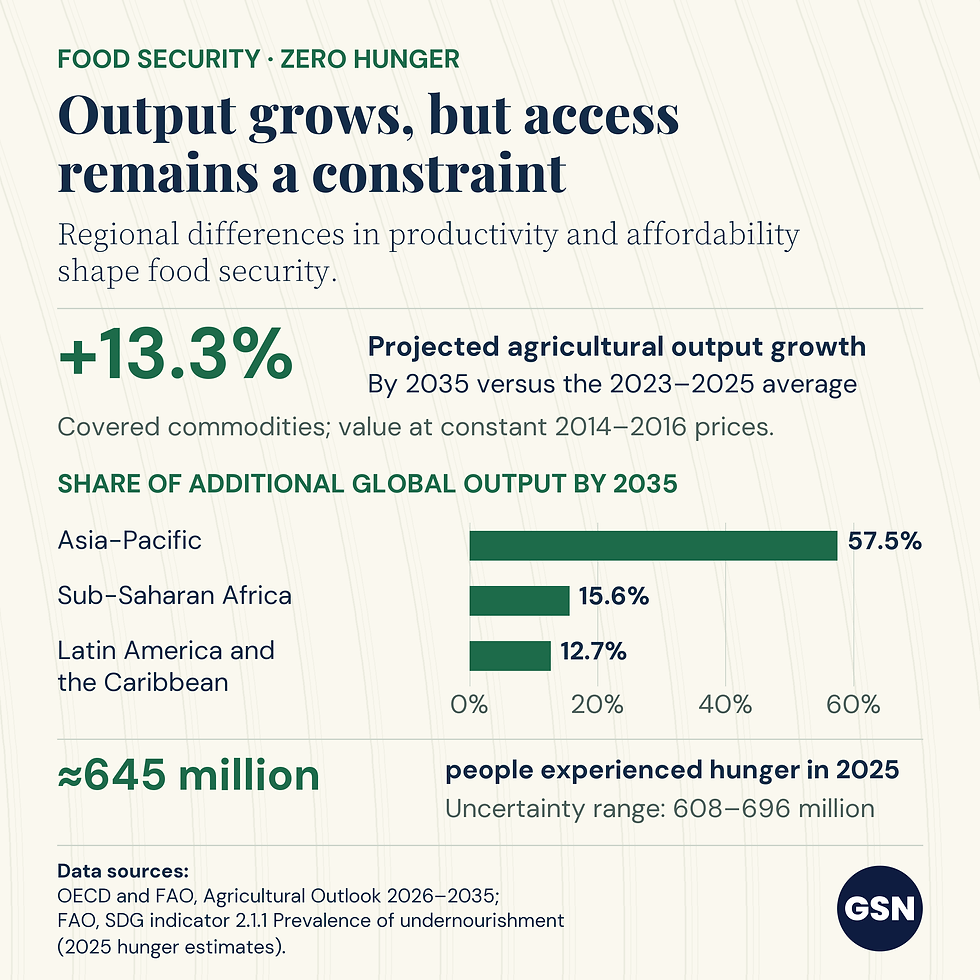
The OECD-FAO Agricultural Outlook 2026-2035 projects further growth under its baseline assumptions. For the commodities it covers, the gross value of agricultural production, measured at constant 2014-2016 prices, is projected to rise by 13.3% by 2035 compared with the 2023-2025 average. This is a value-weighted measure of output, rather than an increase in tonnes or food calories. The baseline uses data and policies available by December 2025.
The baseline envisages rising production alongside demand over the coming decade. It does not establish that food will be affordable, nutritionally adequate or accessible to every household, or that output will remain sufficient through the population peak later this century. Climate shocks, conflict, energy and fertiliser costs, resource constraints and trade disruption create uncertainty around these projections.
Enough food globally does not mean food security
The distinction between production and access remains visible in hunger data. FAO estimates that about 645 million people, or 7.8% of the world population, experienced hunger in 2025. Its uncertainty range is 608 million to 696 million people. The central estimate was about 14 million lower than in 2024, but aggregate agricultural output alone does not explain changes in hunger.
Food insecurity is shaped by more than the physical quantity produced. Income, food prices, conflict, storage, transport and market access affect whether households can obtain adequate food. This is directly relevant to SDG 2 (Zero Hunger), whose targets cover access to safe, nutritious and sufficient food, agricultural productivity and resilient food production systems.
Africa and demographic growth
Sub-Saharan Africa faces rapid population growth alongside low agricultural productivity and substantial hunger. The 2026-2035 Outlook projects annual population growth of about 2.2%, the fastest among its major regions. Longer-term UN projections also identify sub-Saharan Africa as a major centre of future population growth.
An illustration of the productivity gap appears in the OECD-FAO Agricultural Outlook 2025-2034. It reported that sub-Saharan Africa had more than three times North America’s beef cattle herd, while output per animal was about one-tenth as high. The comparison concerns beef cattle productivity, rather than agriculture as a whole, and does not establish that the North American level is attainable in every African farming system.
FAO estimates that approximately 309 million people in Africa were undernourished in 2025, equivalent to about one in five people. Separately, the 2026-2035 Outlook projects sub-Saharan Africa to provide 15.6% of additional global agricultural output by 2035, compared with 11.2% in the previous decade. These production shares use the Outlook’s constant-price measure. Africa-wide hunger figures and sub-Saharan production projections cover different geographical areas.
Asia: demographic divergence inside the largest market
Asia is moving in more than one demographic direction. China’s population is declining, while India and several South and Southeast Asian countries continue to grow. The latest OECD-FAO projections expect lower-middle-income economies, particularly India and Southeast Asia, to remain major sources of consumption growth as population, income and urbanisation reshape diets.
The 2026-2035 Outlook projects Asia-Pacific to contribute about 57.5% of the increase in global agricultural output, measured at constant prices, with India accounting for about 25.6% of the global increase. These shares concern additional output, rather than shares of total production. Asia contains both large sources of demand growth and major sources of projected production growth.
The regional equation is increasingly influenced by diet as well as headcount. Rising incomes are associated with greater consumption of livestock and fish products in many middle-income economies, increasing demand for feed and other agricultural inputs. Diet composition therefore increasingly affects the resources required to supply food.
Europe and North America: lower demographic pressure
Europe and North America face a different balance. Population growth is slow or negative in many European countries, while the Outlook describes high-income agricultural systems as having high productivity and substantial capital use. Its 2026-2035 projections anticipate relatively limited production growth in North America and Europe and Central Asia, citing resource constraints and regulatory factors. These regional groupings are broader than Europe alone.
Their importance to global food security nevertheless extends beyond domestic demand. Agricultural trade connects surplus and deficit regions, and the OECD-FAO outlook continues to identify international trade as critical for balancing supply and demand when production and consumption are geographically separated.
Latin America and Oceania: export capacity with environmental constraints
Latin America and the Caribbean combine slowing demographic growth with substantial agricultural export capacity. The 2026-2035 Outlook projects the region to contribute about 12.7% of additional global agricultural output. Brazil, Argentina and other producers remain important suppliers of cereals, oilseeds, meat and other commodities to international markets.
Output growth also has environmental implications. The Outlook distinguishes direct agricultural emissions from emissions associated with land-use change. Increasing production through greater land use or larger livestock herds can carry different environmental costs from growth based on productivity. A rise in aggregate output therefore does not by itself establish environmental sustainability.
Australia and New Zealand have smaller populations than the major Asian markets but substantial agricultural export roles. The Outlook identifies New Zealand as a major dairy exporter and Australia as a supplier of cereals and livestock products. Weather-related shocks remain a source of uncertainty: drought, heat stress and variable rainfall can affect feed availability and grazing systems.
Geography and access shape food security
The sources examined project slower global population growth and further agricultural expansion over the medium term. They do not establish an inevitable global production shortfall, but neither do they demonstrate that food supply will remain adequate through the projected population peak in the mid-2080s.
Population growth, agricultural capacity and purchasing power are unevenly distributed. The Outlook projects persistent production surpluses and deficits and continuing trade between them. Transport, storage, agricultural inputs and functioning markets affect how these supplies move and whether households can obtain them.
Comparing global population with global output therefore leaves important questions unresolved. Hunger can persist where food is unaffordable or inaccessible even when supplies are available elsewhere. Medium-term production projections describe one part of food security; the regional distribution, resilience and affordability of that production remain material constraints.
Written by a human author, edited with AI assistance.
Further information:
• United Nations, World Population Prospects 2024. Supports the global population peak and regional demographic projections. https://www.un.org/sustainabledevelopment/blog/2024/07/press-release-wpp2024/
• OECD and FAO, Agricultural Outlook 2026-2035. Supports constant-price output growth, regional shares and trade projections.
• FAO, Agricultural production statistics 2010-2024. Documents the growth in cereal and oil-crop production. https://www.fao.org/statistics/highlights-archive/highlights-detail/agricultural-production-statistics-2010-2024/
• FAO, SDG indicator 2.1.1 Prevalence of undernourishment. Provides 2025 global and African hunger estimates and the global uncertainty range. https://www.fao.org/sustainable-development-goals-data-portal/data/indicators/2.1.1-prevalence-of-undernourishment/
• OECD and FAO, Agricultural Outlook 2025-2034. Provides the comparison of beef cattle productivity in sub-Saharan Africa and North America. https://www.oecd.org/en/publications/oecd-fao-agricultural-outlook-2025-2034_601276cd-en/full-report/agricultural-and-food-markets-trends-and-prospects_d3812d71.html


