
Cocoa traceability gains expose gaps in farmer income and retailer accountability


Published on 31 October 2026 at 01:38 GMT
By Editorial Team SDG12
Cocoa companies are disclosing more about where their beans originate, but greater visibility leaves unresolved questions about farmer incomes and supermarket sourcing. The seventh Chocolate Scorecard brings those questions together as price volatility affects growers, manufacturers and retailers. Its findings describe progress in tracing supplies alongside continuing gaps in the evidence about conditions on farms.
The assessment’s central distinction is between knowing where cocoa comes from and demonstrating what happens to the people producing it. A traceable purchase can identify a supplier without establishing whether a farming household earns enough to live on. Equally, information supplied confidentially to researchers is different from information available to consumers or farming communities.
What the traceability figures show
The Chocolate Scorecard says every company with a traceability system shared its data with the assessment. Its headline findings put farmer-group traceability at 84% and individual-farmer traceability at 67% for volume bound for markets covered by the European Union’s Deforestation Regulation (EUDR). However, its detailed explanation describes these as results for companies whose compliance exposure exceeds half their cocoa volume. They are therefore not a measure of all cocoa traded worldwide.
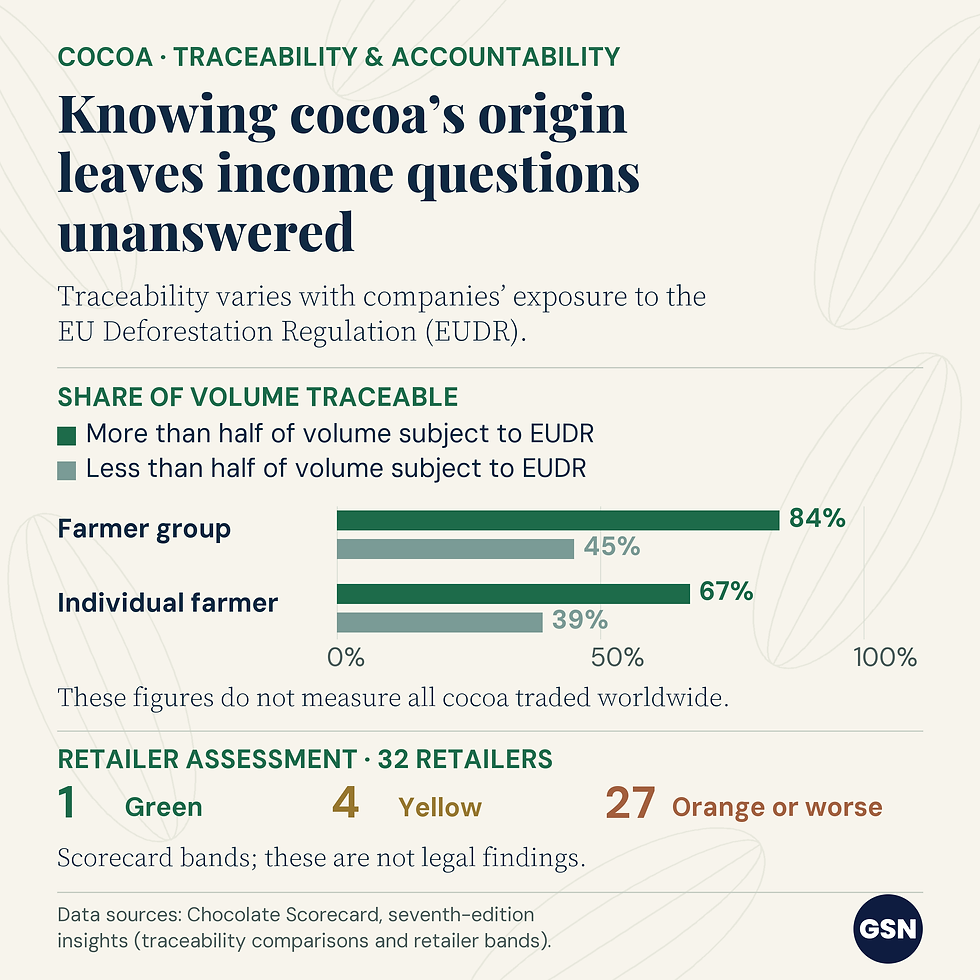
That detailed comparison reports 45% traceability to farmer group and 39% to individual farmer among companies with less than half their volume subject to the regulation. The distinction matters: a result for businesses with greater European market exposure cannot automatically describe the sector as a whole. The source also reports an 8% gain in farmer-group traceability since 2025, without clearly identifying that headline change as a relative increase or a percentage-point movement.
Fuzz Kitto’s message on the assessment’s website describes a decade of movement from uncertainty towards knowledge, with the next decade focused on closing the remaining gap. The statement is an ambition expressed by the Chocolate Scorecard, rather than evidence that better disclosure has already delivered higher incomes.
How the assessment works
Coordinated by Be Slavery Free, the Chocolate Scorecard brings together universities, consultants and civil-society groups. Its methodology describes a questionnaire completed by company personnel, with the seventh-edition survey period running from 10 December 2025 to 6 March 2026. The evidence therefore reflects a defined reporting exercise rather than continuous observation of every transaction.
Seven core categories cover traceability and transparency, living income, child and forced labour, deforestation, agroforestry and climate, pesticides, and gender. Farmer health is an additional category. This breadth means that disclosure about origin is only one part of the assessment, rather than a substitute for its social and environmental questions.
Retailers and their own brands
In its headline retailer findings, the Chocolate Scorecard places one of 32 retailers in green, four in yellow and 27 in orange or worse. These are the initiative’s own assessment bands. They do not establish a legal finding against every business in the lower categories, nor do they describe every supermarket worldwide.
Private-label chocolate competes beside branded products on the same shelves. Their presence connects supermarket procurement to the sourcing questions raised for branded manufacturers. The initiative reports that some retailers link their chocolate to existing programmes operating in producing communities. That description does not establish that all such arrangements deliver equivalent results.
Price shocks and household income
Independent context comes from the Food and Agriculture Organization of the United Nations, whose July 2026 analysis of coffee, cocoa and tea markets describes uneven transmission of international price shocks. It identifies concentrated production, smallholder farming and long supply chains as structural features that leave producers exposed while retail prices respond differently.
The analysis links cocoa’s sharp price rise in 2023–2024 to adverse weather and plant disease affecting output in Côte d’Ivoire and Ghana. Higher international prices do not translate one-for-one into higher payments to farmers. Raw commodities also represent only part of final product costs, helping explain why chocolate prices and bean prices can follow different paths.
An expensive chocolate bar therefore does not establish an improved farmer income. Price, production costs and quantities harvested remain separate components of a household’s earnings.
The practical question is how purchasing arrangements distribute exposure when prices rise or fall. Traceability can identify the households within a supply chain; it does not, by itself, establish how much income those households retain after production costs.
Child labour after the 2020 deadline
The historical commitment was more specific than a promise to eliminate all child labour by 2020. The 2010 framework supporting the Harkin–Engel Protocol set a target of a 70% aggregate reduction in the worst forms of child labour in the cocoa sectors of Côte d’Ivoire and Ghana by 2020. The original framework records that target. The Chocolate Scorecard’s 2026 findings describe continuing child labour alongside increased disclosure.
The assessment reports that 94% of large companies shared child-labour data in 2026. Greater reporting can expose cases previously unseen; it is not itself proof that prevalence has fallen. The initiative distinguishes detection from prevention, identifying school access, household income and access to adult labour as features of programmes it rates highly.
Agroforestry beyond tree planting
The Chocolate Scorecard describes agroforestry as combining cocoa with retained, naturally regenerating or planted trees. Potential benefits include carbon storage, soil moisture retention, biodiversity and diversified farm income. Those benefits depend on the species mix and the conditions on each farm, rather than tree numbers alone.
Yet the initiative reports that few companies have a dedicated cocoa-agroforestry policy, with most incorporating the issue into broader strategies or certification arrangements. This leaves a distinction between a stated interest in trees and evidence about the area covered, farm design and benefits reaching growers. Agroforestry consequently connects environmental reporting to the same question raised by income programmes: what changes on the farm?
Pesticide policies and operational evidence
Only 20% of companies actively collected pesticide data in their supply chains, according to the Chocolate Scorecard. Its description of leaders highlights programmes that help farmers reduce pesticide use through pest management, extending beyond policies about permitted chemicals or safe application.
The website’s claim that 44% of cocoa farmers suffer acute pesticide poisoning annually cannot be treated as an established cocoa-specific rate. The widely cited 44% estimate concerned farmers globally in a 2020 review that was subsequently retracted. A September 2026 reassessment by Wolfgang Boedeker and colleagues estimates approximately 46% globally, using research and mortality data, rather than a representative survey of cocoa growers. Its extrapolated estimate indicates a wider agricultural health burden; it does not establish a poisoning rate for the cocoa sector.
Measuring changes on farms
This reporting connects to SDG 12 (responsible consumption and production) through the relationship between sourcing information, purchasing practices and the impacts of consumer products. The available evidence separates several questions that are sometimes compressed into a single claim of sustainability: whether origin is known, whether information is disclosed, and whether farmers’ circumstances improve. Progress on the first leaves the others open to further measurement.
Written by a human author, edited with AI assistance.
Further information:
Chocolate Scorecard, seventh-edition insights support the traceability, retailer, child-labour, agroforestry and pesticide findings, and Kitto’s stated ambition.
Chocolate Scorecard, methodology explains coordination, survey dates, participation and assessment categories.
Food and Agriculture Organization of the United Nations, July 2026 analysis explains price shocks and uneven transmission along beverage supply chains.
International Cocoa Initiative, the original 2010 Framework of Action records the 70% reduction target for the worst forms of child labour by 2020.
Boedeker and colleagues, the September 2026 reassessment explains the global pesticide-poisoning estimate and the earlier review’s retraction.


