
The global sand crisis hidden inside modern construction


Published on 4 October 2026 at 01:50 GMT
By Editorial Team SDG12
Modern construction depends on a material whose removal can undermine the landscapes supporting it. Sand goes into concrete, asphalt and glass, while enormous quantities of sediment create reclaimed land. The global sand crisis concerns the availability of suitable material and the damage caused by extracting it from rivers and coasts, rather than the disappearance of every grain on Earth.
The United Nations Environment Programme (UNEP) estimated annual use of sand resources at 40–50 billion tonnes in its 2022 assessment. The report uses that term broadly to include sand, gravel and crushed stone, rather than sand alone. This is an estimate, not a complete global inventory, and covers materials used in construction and other applications.
In May 2026, UNEP released a further assessment warning that growing demand was outpacing sustainable supply. Its announcement reported that sand use for buildings could rise by up to 45 per cent by 2060. That is a projection, not a measured increase or a forecast for every use of sand.
Why a desert is not an unlimited building supply
Sand is a description of granular material, not a guarantee of construction performance. Concrete combines cement, water and aggregates, including sand and gravel. Different deposits do not behave identically when incorporated into a mixture, and the abundance of dunes does not make them interchangeable with river deposits.
UNEP’s 2014 assessment describes windblown desert sand as generally unsuitable for conventional concrete because of its rounded grains, while noting that some desert sand can be used when mixed with other materials. Suitability therefore depends on the material and the mixture, rather than simply on whether the sand comes from a desert.
Marine aggregates present another constraint. Salt removal through washing is important because residual salts can contribute to corrosion of steel reinforcement. A deposit's proximity to a construction project therefore does not, by itself, establish its suitability. Extraction, treatment and the intended application are separate questions.
When removal changes the river
Rivers transport sediment as well as water. Where extraction exceeds replenishment, removing material can lower the bed and destabilise banks. A peer-reviewed study published in 2020 by Christopher Hackney and colleagues examined this mechanism in the lower Mekong River.
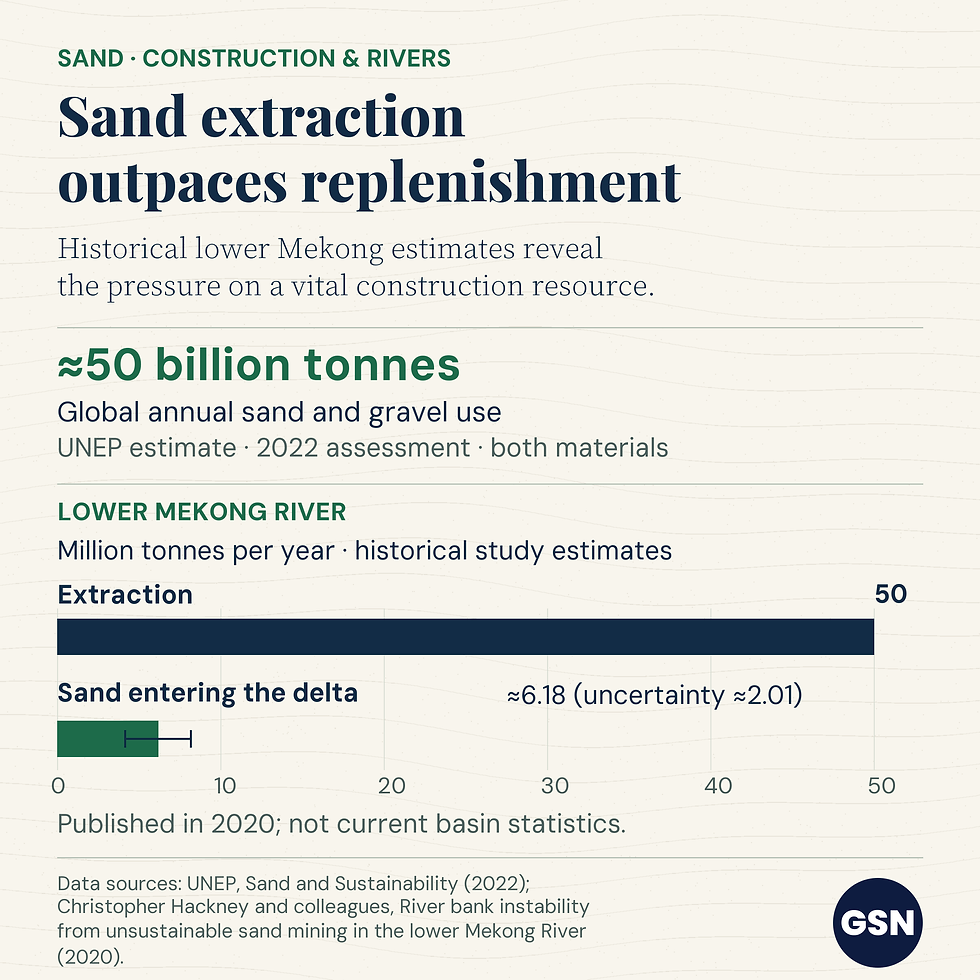
The researchers estimated sand entering the delta at 6.18 million tonnes annually, with an uncertainty of ±2.01 million tonnes. They compared this with an estimated 50 million tonnes of annual sand extraction based on surveys in four Mekong basin countries in 2011–2012. These are historical estimates with different geographical scopes, not current measurements of a single river reach. Their modelling showed how bed lowering could destabilise riverbanks, potentially damaging housing and infrastructure and threatening lives.
This makes the location and rate of extraction consequential. A river can contain visible sand while losing it faster than sediment transport replaces it. The research does not establish that every eroding bank has one cause, but it identifies a physical pathway through which sand removal can expose riverside communities to harm.
Coastal deposits perform different but connected functions. UNEP's 2026 assessment describes sand as habitat and as protection against erosion, storm surges and saline intrusion into coastal aquifers. Its removal can put fisheries, tourism and water security under pressure. Material sold as a construction input can therefore have economic value before it is excavated, through the services provided by the ecosystem containing it.
Illegal extraction and the corruption connection
Environmental damage and illegality are not identical categories. Harm depends on extraction conditions, while illegality concerns the rules applying to an operation. An assessment of the sector consequently involves both ecological evidence and questions about permits, oversight and enforcement.
The United Nations Office on Drugs and Crime (UNODC) documents how corruption can facilitate illegal mining through interactions with licensing bodies, inspectors, customs and other authorities. Its 2022 report on environmental crime records a case in which a national park director extracted and sold sand from a protected park without registration or a permit.
The example shows how an official entrusted with oversight can participate directly in extraction. The report also describes separate mining cases involving leaked enforcement information and advance warning of inspections. Those examples concern mining more broadly; they do not establish that every sand supply chain operates through bribery.
The cases illustrate different forms of abuse of public office, from direct involvement in extraction to disclosure of enforcement information. They provide evidence of specific offences rather than a measure of how widespread corruption is across the sand sector.
What alternatives can replace
Recycled construction materials and manufactured sand can reduce demand for newly extracted river and coastal deposits in suitable applications. They address different parts of the supply chain. Recycling recovers material already used, whereas manufactured sand generally comes from crushing stone.
UNEP's 2022 assessment identifies recycled construction and demolition waste as a source of aggregates for roads, concrete and asphalt. It explains that hazardous and non-inert materials require separation, including removal of asbestos and tar-contaminated material. Recycling is therefore a processing and quality-control activity, rather than the direct substitution of mixed rubble for construction sand.
Crushed stone provides another supply, but production still involves extraction and processing. Substituting a quarry source for a river source changes the location and nature of the impacts. Transport also affects feasibility: the report notes that sand markets are predominantly local because moving the material influences its economics.
These choices connect to SDG 12 (Responsible Consumption and Production) through material efficiency, reuse and waste recovery. The practical question is how much suitable secondary material can replace primary supply in a particular market. A recycled aggregate used in a road does not automatically resolve demand for every concrete mixture, glass product or reclamation project.
The strategic significance of sand lies in that combination of functions. Construction consumes it, communities depend on the environments containing it, and alternatives have their own processing requirements. The available evidence describes a resource whose price, physical suitability and ecological role cannot be assessed as a single question of tonnage.
Written by a human author, edited with AI assistance.
Further information:
UNEP, Sand and Sustainability: 10 strategic recommendations to avert a crisis (2022), explains the scale of aggregate use, local market economics and the treatment of recycled construction materials.
UNEP, May 2026 assessment announcement, supports the buildings-demand projection and the ecological functions of sand.
UNEP, Sand, rarer than one thinks (2014), explains desert sand limitations, marine aggregate treatment and construction uses.
Christopher Hackney and colleagues, River bank instability from unsustainable sand mining in the lower Mekong River (2020), provides historical sand-flow estimates and modelling of bank instability; the link leads to the accepted manuscript.
UNODC, Preventing and combating corruption as it relates to crimes that have an impact on the environment (2022), documents corruption risks and the protected-park sand case.


