
The global race to remove carbon dioxide from the atmosphere


Published on 17 September 2026 at 04:14 GMT
By Editorial Team SDG13
Governments and companies are financing machines, minerals and land management to extract carbon dioxide from the atmosphere, as climate strategies increasingly extend beyond preventing new pollution. The scientific case concerns both emissions that remain difficult to eliminate and carbon accumulated over industrial history. The unresolved question is how much removal can be delivered without weakening efforts to stop adding more.
Cutting emissions slows the addition of carbon dioxide; it does not itself extract the accumulated stock. Reaching net zero CO2 means balancing remaining human emissions with human removals. Sustained net negative emissions could gradually reduce warming after a temperature overshoot, according to the Intergovernmental Panel on Climate Change (IPCC). Its assessment also finds that overshoot exposes societies and ecosystems to additional harm, some irreversible. Later removal cannot guarantee the reversal of every consequence.
Investment ahead of delivery
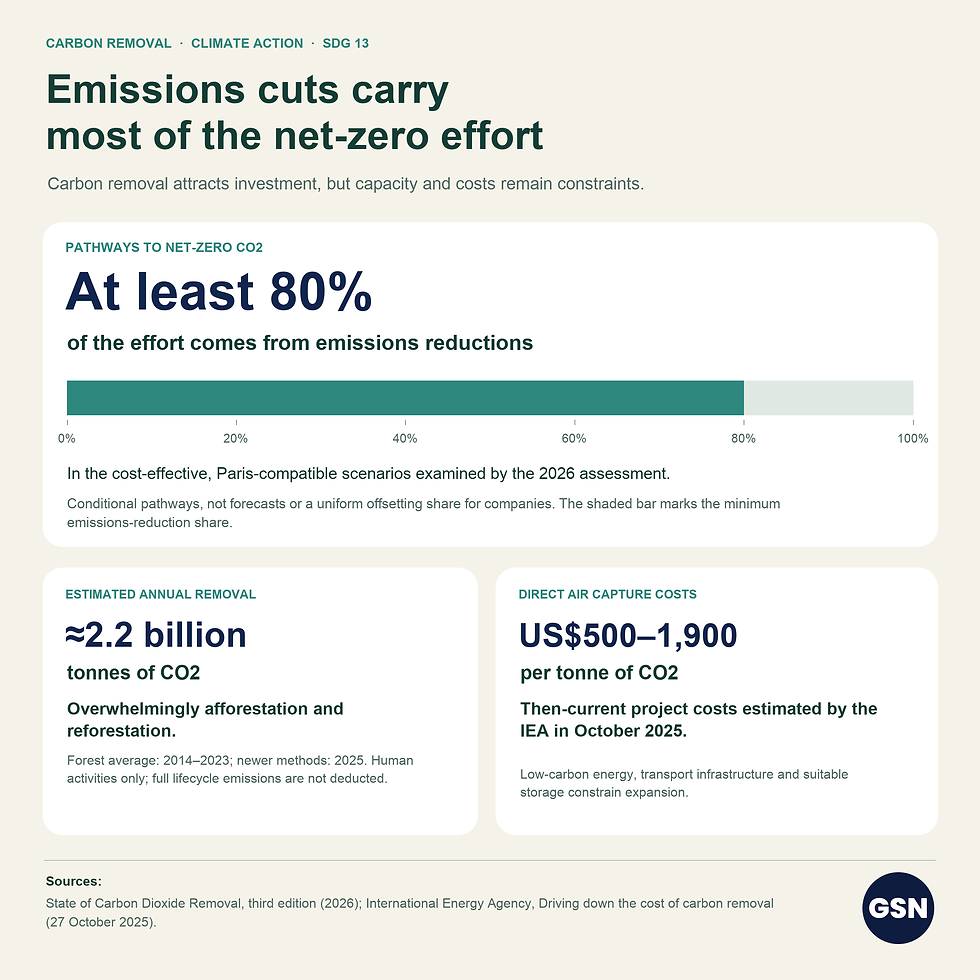
The 2026 State of Carbon Dioxide Removal assessment estimates annual atmospheric removal at approximately 2.2 billion tonnes of CO2, overwhelmingly through afforestation and reforestation. The forest estimate is an average for 2014–2023; newer methods, assessed for 2025, contribute only a tiny fraction. These estimates concern human activities, not all natural uptake by oceans and vegetation, and do not deduct emissions from the full project lifecycle.
Public procurement is one route to building demand. In October 2024, the Government of Canada announced plans to buy at least C$10 million in removal services by 2030 for its operational net-zero strategy. It presented the purchases as support for both balancing remaining emissions and developing technologies and markets.
The 2026 assessment reports that demand stems mainly from voluntary net-zero commitments, with Microsoft dominating contracted novel removals in 2024–2025. Advance contracts can help projects secure financing, but most contracted novel removals have yet to be delivered. A purchased tonne, a facility's advertised capacity and a tonne already removed are different measures of progress.
Machines and the energy constraint
Direct air capture uses chemical materials to separate dilute CO2 from ambient air. Durable removal follows when that carbon is stored underground or mineralised. Capturing fossil CO2 at a factory before its release generally avoids emissions rather than withdrawing historical atmospheric carbon; using captured carbon in fuel also releases it again when burned.
In October 2025, the International Energy Agency (IEA) estimated then-current direct air capture project costs at US$500–1,900 per tonne of CO2. It described roughly US$300 by mid-century as a possible outcome of technological progress and scale, not an achieved industry price. Processing large volumes of air demands energy; low-carbon electricity and heat, transport infrastructure and suitable storage constrain expansion. Geological and mineral storage can endure for millennia, but site selection, monitoring and lifecycle emissions determine the net result.
Biochar and weathering on farmland
Biochar is produced by heating biomass with little oxygen, retaining some of the carbon previously captured by plants in a relatively stable solid. The 2026 assessment cites future cost estimates of US$70–360 per tonne of CO2, including assumptions about supply chains, processing and electricity revenues. These are modelled estimates, not a universal price for verified delivery. Durability varies with feedstock, production conditions and the receiving environment; some carbon can remain for centuries or longer.
Biochar can improve soils, although benefits vary by location. Its expansion depends on sustainable biomass supplies, processing equipment and transport. Biomass has competing uses, including energy production and other removal methods. Diverting it changes both the economics and the carbon balance. Pyrolysis can yield usable energy, but harvesting and processing emissions still enter the calculation.
Enhanced rock weathering spreads crushed reactive rock, often basalt, to accelerate chemical reactions that consume CO2. Carbon can ultimately be stored in dissolved bicarbonate or carbonate minerals. The 2026 assessment reports cost estimates commonly ranging from US$50 to more than US$300 per tonne of CO2, with detailed lifecycle assessments sometimes exceeding US$1,000. Crushing, grinding and transport dominate costs and consume energy.
The chemistry offers long-lived storage, but field performance depends on minerals, climate and soil conditions. Rock application precedes removal: the amount spread is not equivalent to atmospheric CO2 already captured. Measuring uptake and tracking subsequent carbon losses remain difficult. Large deployment also entails quarrying, freight, dust exposure and possible trace-metal contamination, alongside potential improvements in soil conditions.
Restoration and other routes
Ecosystem restoration uses photosynthesis and recovering carbon stocks rather than an energy-intensive air separation process. Forest restoration can combine carbon uptake with habitat benefits. For forest-based methods, the 2026 assessment cites removal costs at scale around US$5–53 per tonne of CO2, within a much wider literature range. It notes a limited evidence base and that monitoring and transaction costs can raise the total. These figures do not establish a price for restoration generally, particularly wetlands.
Living carbon stores face fire, drought, pests and changes in land use. Forests and soils also approach saturation, so uptake cannot increase indefinitely. Land availability, food production and community interests limit expansion. Preventing deforestation or stopping peat degradation primarily avoids further releases; additional carbon accumulated through recovery is the removal component. The two can coexist within one project but are not interchangeable.
Bioenergy with carbon capture and storage, or BECCS, captures plant-derived CO2 during industrial processing and stores it underground. The IEA placed first-of-a-kind project costs at US$75–300 per tonne of CO2 in 2025. Concentrated CO2 streams can reduce capture costs, but biomass production, transport and land-use effects influence whether the process delivers net removal.
Ocean alkalinity enhancement seeks to increase seawater's capacity to absorb atmospheric CO2. Its feasible scale remains uncertain: energy and material demands, verification and marine ecological effects complicate deployment. The 2026 assessment also cautions that cost estimates across removal methods differ in scope and maturity, limiting direct comparisons.
The risk of postponing emissions cuts
The central policy tension concerns what removal is being asked to compensate for. The 2026 assessment finds that emissions reductions supply at least 80% of the effort to achieve net-zero CO2 in the cost-effective Paris-compatible scenarios it examines. Those scenarios are conditional pathways, not forecasts, and do not specify a uniform offsetting share for individual companies
If governments or companies defer reductions on the expectation of inexpensive future removal, they depend on capacity, finance and durable storage that may not materialise. The IPCC finds that faster emissions cuts reduce the amount of later removal required and its associated sustainability risks. This connects the debate directly to SDG 13 (Climate Action): the pace of reductions affects both peak warming and the scale of the subsequent removal task.
Carbon accounting adds another test. The 2026 assessment identifies additionality, conservative measurement, permanence and avoidance of double counting as criteria for credit quality. Additionality concerns whether removal would have occurred without the intervention; the other criteria address its quantity, durability and exclusive accounting. Assessing whether removal complements decarbonisation therefore involves actual emissions trajectories and verified storage, as well as investment announcements.
Written by a human author, edited with AI assistance.
Further information:
State of Carbon Dioxide Removal, third edition, 2026. Chapters 1, 4, 7, 8 and 10 support the deployment, market, accounting, durability and comparative cost findings.
International Energy Agency, Driving down the cost of carbon removal, 27 October 2025. This analysis provides dated direct air capture and BECCS cost estimates and explains energy and investment constraints.
Intergovernmental Panel on Climate Change, 2023 Synthesis Report, longer report. Section 3.3 explains net-zero pathways, temperature overshoot and the relationship between faster emissions cuts and subsequent removals.
Government of Canada, carbon removal procurement announcement, 9 October 2024. This release documents the announced C$10 million commitment and its operational net-zero rationale.
Intergovernmental Panel on Climate Change, Climate Change 2022: Mitigation of Climate Change, Chapter 12. Section 12.3 reviews carbon-removal methods, including enhanced weathering chemistry and environmental risks.


